
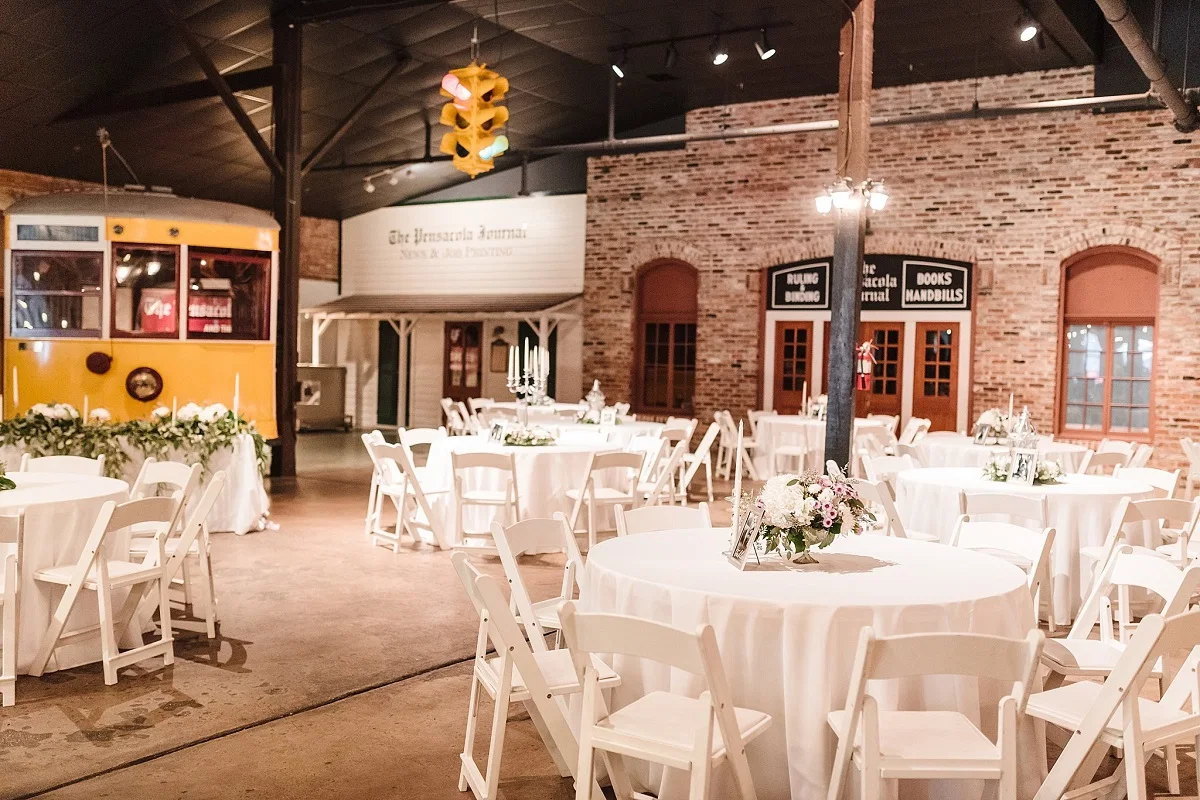
Museum of Commerce Event Space is an inside-the-building heritage room, not a public plaza.
The useful read is controlled interior circulation, closer guest proximity, and a venue where exhibits, finishes, and historical tone need more respect than a broad outdoor activation perimeter would.
That makes it a different operating brief from Museum Plaza, where the main challenge is public visibility, perimeter control, and weather-sensitive staging in open air.
Execution priorities for Museum of Commerce Event Space
- Interior heritage-room discipline and artifact sensitivity
- Tighter guest proximity and curated room atmosphere
- Controlled indoor flow instead of open public perimeter
The Pensacola event landscape
Trade show weeks in Pensacola compress decisions.
Pensacola Bay Center remains the core indoor venue in the target market, with twelve meeting rooms and more than 20,000 square feet of arena floor space marketed for trade shows, conventions, exhibits, lectures, and banquets, which sets the practical ceiling for a booth program working the market.
How Pensacola floor operations work
Labor in Pensacola runs venue-by-venue, not citywide.
A public Event Manager posting for Pensacola Bay Center references conducting advances, scheduling and supervising labor calls, processing equipment orders, and coordinating front-of-house staff, police, EMS, and licensed security.
Scope at Museum of Commerce Event Space
a bad one has many, because they weren't.
Out of scope by default are show organizer fees, booth lease costs paid directly to the show, staff travel and per diems, and any custom software or data-capture tooling the client runs on its own stack. Those stay on the client side and plug into the project through coordination, not rebilling.
How a project runs
Venue coordination comes next.
Install days are owned by a single on-site lead.
During show hours, the booth is a live operating space.
That document drives the next booking.
What it costs and how fast it moves
Cost scales with how it is built, how big it is, what the venue charges for its own services, what the graphics look like, how far the crates travel, and how many days the team stays on-site.
Lead time drives everything. Custom: 16 to 20 weeks. Rental: 8 to 12.
Outcomes we optimize for
Trade show ROI is measured at the lead and pipeline level.
A week after the show, the booth's actual floor performance is already clearer than any pre-show projection. We document those observations alongside the technical closeout so the next cycle inherits real signal, not nostalgia.
How we're built to run your project
Trade Show Services of Pensacola keeps the work local.
The difference from a national vendor shows up at the dock.
The Museum of Commerce Event Space footprint
Museum of Commerce Event Space is part of the active Pensacola venue set.
Located at 201 East Zaragoza Street, Historic Pensacola / Downtown.
Frequently asked questions
How does labor work in Pensacola?
It runs venue by venue.
How much lead time is ideal?
Custom builds run best with 16 to 20 weeks of lead time. Rentals take 8 to 12 weeks.
What information kicks off a project?
The show, the venue, the booth number, the dates, and a target budget range. From those, an initial scope and a realistic cost come back within a few days.
Who runs the booth on-site?
One named show-site lead runs the install, the show hours, and the strike. That person carries the floor plan and the punch list from crates to doors and reports up once a day.
Can the booth travel to the next city on our calendar?
Same structure, swappable graphics, standard crates.
What happens if something breaks during show hours?
The on-site lead handles it.